From the Front Bar to the Live Table: How the Great Aussie Pub Gave Birth to Online Casino Culture
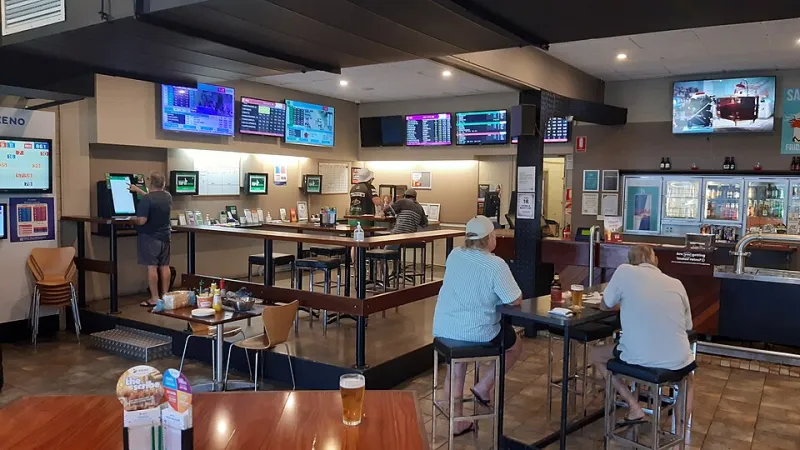
Photo: Ridiculopathy, CC0, via Wikimedia Commons
Picture the scene. It's a Thursday evening somewhere in regional New South Wales. The ceiling fans are working overtime, the telly above the bar is showing the replay of last weekend's footy, and someone's arguing good-naturedly about a hand of cards from twenty minutes ago. Nobody's in a hurry. Nobody's alone. The whole room hums with that particular kind of easy, lived-in sociability that Australians do better than almost anyone.
Now open your laptop. There's a live dealer on screen — a real person, in a real studio, dealing real cards. The chat box is running. Someone just typed a joke. The dealer laughed. You're three thousand kilometres from the nearest pub, and somehow, it feels like you're sitting at the bar.
That's not an accident. It's cultural continuity — and it's the story of how Australia's pub scene quietly became the blueprint for the country's love affair with live casino gaming.
The Pub as Social Infrastructure
To understand why live dealer games landed so well in Australia, you have to understand what the pub actually is here — and it's not just a place to drink.
The Australian pub, in its truest form, is a community hub. From the grand heritage hotels of inner Melbourne to the corrugated iron watering holes of the outback, the pub has historically been where Australians process the week. You celebrate there, commiserate there, argue and reconcile and laugh there. The counter meal, the meat raffle, the TAB terminal in the corner, the pokie room out the back — all of it is part of a single ecosystem designed around one core human need: company.
For decades, the gaming element of pub culture was inseparable from the social element. You didn't just play the pokies — you played them with your mate two machines over, shouting across occasionally, sharing in the small dramas of near-misses and unexpected wins. The pokie room was loud, slightly chaotic, and entirely communal even when everyone was technically playing solo.
That distinction matters. Australians learned to enjoy gaming as a social activity first. The game itself was almost secondary to the context around it.
The Problem with Early Online Gaming
When online casinos first arrived in earnest during the late 1990s and early 2000s, they were technically impressive and socially barren. You sat alone, clicked buttons, and received automated responses. The RNG (random number generator) was invisible and impersonal. There was no banter, no shared moment, no sense that anyone else in the world was experiencing what you were experiencing at the same time.
For a lot of Australian players, that was a dealbreaker — not consciously, perhaps, but in practice. The numbers bore it out: uptake of online gaming in Australia lagged behind expectations for years, even as internet penetration improved and the product quality got better. Something was missing, and that something was the front bar.
The platforms that cracked the Australian market early were often the ones that understood this gap and tried to fill it — live chat functions, community features, leaderboards that created a sense of shared experience. But these were patches, not solutions.
When Live Dealer Changed Everything
Live dealer gaming — where a real human dealer hosts games via video stream in real time — arrived like someone had finally figured out the puzzle.
Suddenly, there was a face. There was a voice. There was the sound of cards being shuffled and chips being stacked. Other players were visible (in name, at least) around the same table. The chat function wasn't a gimmick anymore — it was a conversation, and the dealer was part of it. Regular players started recognising favourite dealers. Inside jokes developed. The whole thing started to feel, improbably, like a local.
For Australian players, this wasn't just a technical upgrade. It was a homecoming.
The social dynamics that make a pub work — the casual banter, the shared experience of a moment (a big win, a bad beat, a dealer's perfect comic timing) — translated almost perfectly to the live casino format. You could play from your couch in Cairns or your apartment in Fitzroy and still feel like you were part of something communal. The isolation that had always been online gaming's biggest weakness was, if not eliminated, dramatically reduced.
The Banter Economy
Here's something that doesn't get said enough in analyses of gaming culture: Australians are extraordinarily good at banter, and banter requires an audience.
In a pub, the wit flows because there are people to receive it. The bloke who cracks a joke about his own terrible luck at the pokies is performing for the room, not just processing his emotions. It's a social ritual, and it requires participants.
Live dealer chat boxes recreated this economy in miniature. Players who might never speak to each other in real life were suddenly trading quips with a dealer in a Dublin studio or a Manila casino floor. The dealer who remembered a returning player's name, who acknowledged a particularly unlucky hand with a sympathetic wince — these small human gestures were worth more than any bonus offer.
Aussie players responded to this in droves. The live casino category grew faster in Australia than in almost any comparable market, and the social dimension is consistently cited in player feedback as a primary driver of loyalty.
The Outback Watering Hole Goes Digital
There's a specific type of Australian pub that deserves mention here: the remote outback pub. Places like the Birdsville Hotel in Queensland, or the Daly Waters Pub in the Northern Territory — legendary spots where isolation is the whole point and community is built from whoever happens to be passing through.
These places developed a particular kind of generous, inclusive sociability born from necessity. When you're hours from the next town, you make community with whoever's around. The stranger at the bar becomes a mate by the second round. Stories are shared, games are played, and the evening stretches out because nobody's in a rush to go back to the silence.
That same energy — welcoming, unhurried, genuinely curious about the person next to you — is the ideal that live casino gaming aspires to. Whether it always achieves it is another question. But the aspiration is real, and for Australian players who grew up with that cultural reference point, even a partial approximation feels meaningful.
What Comes Next
Live casino technology is only getting more sophisticated. Improved streaming quality, augmented reality overlays, more interactive game formats — the gap between digital and physical is narrowing every year.
But the fundamentals won't change, because the fundamentals are human. Australians want to play with other people. They want a laugh, a bit of drama, and the sense that the person across the table is actually there. The pub taught them that. The live casino delivered it.
At Yabby Casino AU, we reckon that's worth celebrating — because the best gaming experiences have always been about more than the game. They're about the company you keep while you play it.
Pull up a stool. The dealer's waiting.